
Have you ever watched a group of people playing Teen Patti and wondered how they decide which cards are stronger? At first, the game may look confusing, especially when players use terms such as Trail, Sequence, Color, Blind and Show. However, the basic idea becomes much easier once you understand how the cards are arranged and compared.
Teen Patti is a traditional three-card game that has been played in many South Asian households and social gatherings. It uses a regular deck of playing cards, but the way combinations are ranked makes it different from several other popular card games.
This guide takes a beginner-friendly approach. Instead of assuming that readers already know card-game terminology, Teen Patti rules we will start with the deck, explain the main combinations, and then walk through the basic structure of a traditional round.
The purpose of this article is to explain the game as an educational subject, including its rules and terminology. Different versions may use different procedures, Teen Patti rules so readers should always check the rules of the particular version they are studying.
Understanding the Basic Idea of Teen Patti
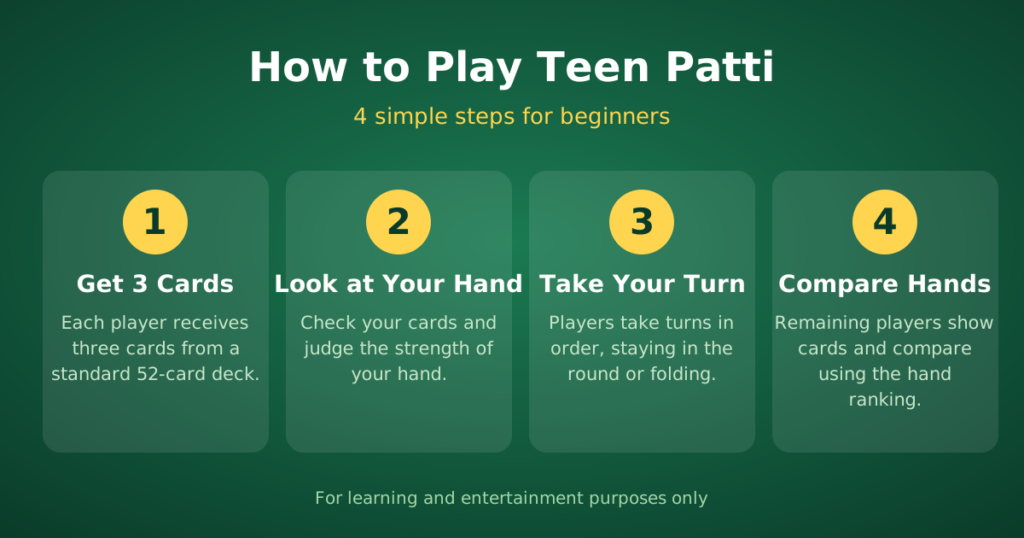
The name Teen Patti literally refers to three cards. That is also the central feature of the traditional game: every participant receives a hand containing three cards.
The cards are usually dealt face down. A participant can examine their own hand according to the rules being followed, while the other participants’ cards remain hidden.
The strength of a hand depends on the combination formed by its three cards. For example, three cards with identical ranks form a Trail, Teen Patti rules while two matching cards form a Pair.
In traditional betting versions, participants may also make decisions about continuing, folding or comparing hands. However, the card-ranking system is the foundation that beginners should learn first.
Getting Familiar with the Playing Cards
Traditional Teen Patti normally uses one standard deck containing 52 cards. Teen Patti rules Jokers are not included in the commonly used version.
The deck is divided into four suits:
- Spades
- Hearts
- Diamonds
- Clubs
Each suit contains 13 cards. These include Ace, King, Queen, Jack and the numbered cards from 10 through 2.
A card has two important characteristics: its rank and its suit.
The rank tells you whether the card is an Ace, King, Queen or another value. Teen Patti rules The suit tells you whether it belongs to Spades, Hearts, Diamonds or Clubs.
Both characteristics matter when identifying a three-card combination.
How Cards Are Distributed
A traditional round begins with a dealer.
Each participant receives three cards, usually face down. 999 3Patti Rules The cards are distributed so that everyone receives the same number.
Consider a simple example involving four participants. Teen Patti rules Each person receives three cards, meaning 12 cards are dealt altogether.
After distribution, the participants follow the agreed rules of their particular game.
There is no need to memorize every possible procedure immediately. Understanding what a three-card hand looks like and how it is ranked is a much easier starting point.
The Six Main Teen Patti Hand Combinations
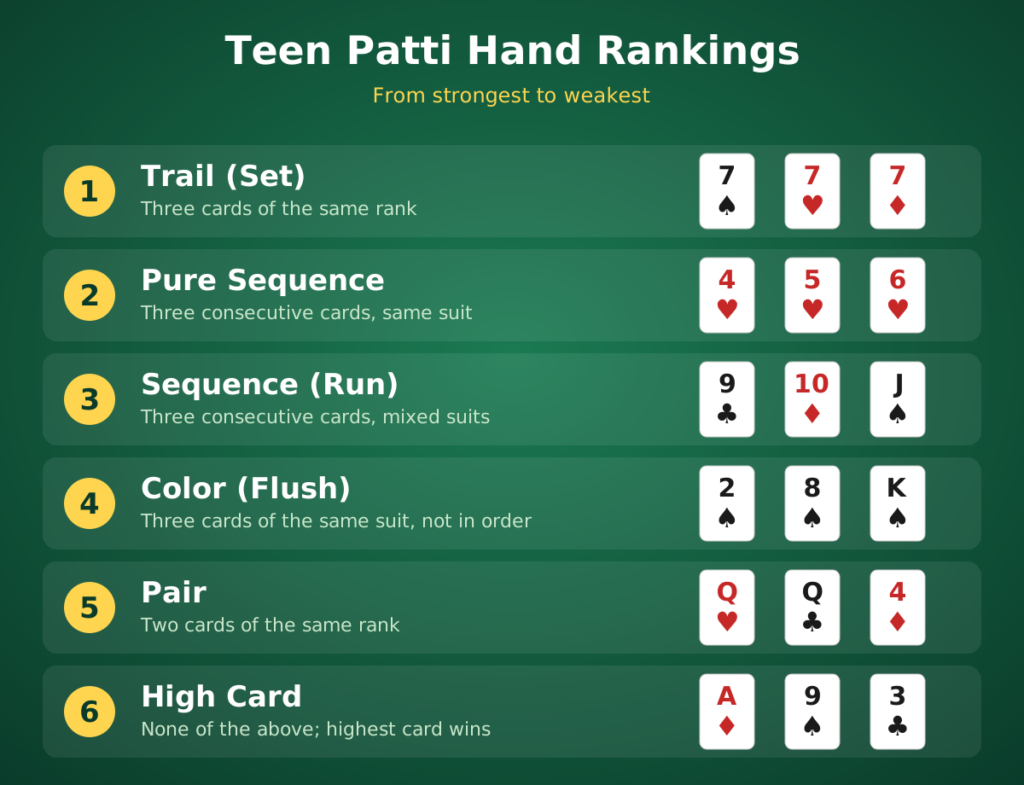
The following combinations are commonly used in traditional Teen Patti. Teen Patti rules Their order is important because it determines which hand has greater strength.
1. Trail: Three Cards with the Same Rank
A Trail is formed when all three cards have an identical rank.
For example:
- 6♠ 6♥ 6♦
- 9♣ 9♦ 9♥
- Q♠ Q♥ Q♦
Notice that the suits do not have to match.
A hand containing three Queens is a Trail, just as a hand containing three Sixes is a Trail. Teen Patti rules When two Trails are compared, the higher rank generally wins.
2. Pure Sequence: Consecutive Cards of One Suit
A Pure Sequence requires three consecutive cards, with all three belonging to the same suit.
For example:
- 3♣ 4♣ 5♣
- 8♦ 9♦ 10♦
- J♥ Q♥ K♥
There are two conditions to remember:
First, the ranks must follow a consecutive order.
Second, all three cards must belong to one suit.
If the cards are consecutive but belong to different suits, Teen Patti rules they do not form a Pure Sequence.
3. Sequence: Consecutive Cards of Different Suits
An ordinary Sequence, sometimes called a Run, also contains three consecutive ranks.
Examples include:
- 4♠ 5♥ 6♦
- 7♣ 8♦ 9♠
- 10♥ J♣ Q♦
A Sequence is commonly ranked below a Pure Sequence.
This distinction is worth remembering because beginners sometimes confuse these two combinations.
4. Color: Three Cards from the Same Suit
A Color is made when all three cards belong to one suit but do not form a consecutive sequence.
Examples:
- 2♥ 7♥ K♥
- 3♠ 8♠ Q♠
- 5♦ 9♦ A♦
The ranks can be different. The shared suit is what identifies this combination.
In some other card games, a similar combination is called a Flush.
5. Pair: Two Matching Cards
A Pair contains two cards with the same rank and one card with a different rank.
Examples:
- 4♠ 4♦ 10♥
- 7♥ 7♣ K♠
- J♠ J♦ 3♥
The third card is sometimes called the kicker in card-game terminology.
When two Pairs are compared, the pair rank is generally considered first. Teen Patti rules If both pairs have the same rank, the remaining card may be used to settle the comparison.
6. High Card: No Matching Combination
A High Card hand is one that does not form a Trail, Pure Sequence, Sequence, Color or Pair.
For example:
- 2♣ 6♥ J♦
- 3♠ 8♦ K♥
- 5♣ 9♥ Q♠
In these examples, there are no matching pairs, three-card groups, or qualifying sequences.
The cards are compared according to the applicable High Card rules.
Complete Teen Patti Hand Ranking Order
For quick reference, here is the commonly used traditional ranking order.
| Position | Combination | Main feature |
|---|---|---|
| 1 | Trail | Three cards of equal rank |
| 2 | Pure Sequence | Consecutive cards of one suit |
| 3 | Sequence | Three consecutive cards |
| 4 | Color | Three cards of one suit |
| 5 | Pair | Two cards of equal rank |
| 6 | High Card | No higher combination |
A higher position generally beats a lower position.
Some versions use special rules for Ace-related sequences and other tie situations. Teen Patti rules Do not assume that every app or regional version uses identical rules.
Blind and Seen: Two Common Terms
People learning Teen Patti will frequently hear the words Blind and Seen. These terms describe whether a participant has looked at their cards.
What Is Blind?
Blind means participating without examining the three cards.
A Blind participant makes decisions without knowing the exact combination in their hand.
In traditional betting versions, Teen Patti rules the permitted betting amounts or limits for Blind participation may differ from those for Seen participation.
The details depend on the rules agreed upon for that version.
What Is Seen?
Seen means that the participant has already viewed their cards.
After looking at the hand, the participant knows which combination they hold. Teen Patti rules It could be a Trail, Pure Sequence, Sequence, Color, Pair or High Card.
Seen is simply a description of the participant’s playing condition. It does not represent a card-ranking category.
What Does Folding Mean?
Folding means leaving the current round rather than continuing to participate.
Once a participant folds, they are no longer eligible to win that round through a later hand comparison.
The exact process for folding depends on the particular rules being followed.
Understanding this term is useful because it appears frequently in descriptions of traditional Teen Patti.
Understanding a Show
A Show refers to comparing eligible hands to determine which combination has the higher ranking. Teen Patti rules
For example, imagine that two participants have the following cards:
Hand A: 5♠ 5♦ 9♥
Hand B: 8♣ 8♥ 3♦
Both hands contain a Pair. The second hand contains two Eights, while the first contains two Fives.
Under the common comparison system, the pair of Eights is stronger.
This example shows why knowing the hand-ranking order is more useful than simply looking at the number of cards with high values.
The conditions for requesting a Show are not necessarily identical in every version.
What Is the Pot?
In traditional betting versions, the pot refers to the amount collected during a round.
Some versions also use a starting contribution called a Boot.
These are betting-related terms rather than card combinations. Teen Patti rules They are included here to help readers understand descriptions of traditional gameplay.
A social game played without money does not need to use a monetary pot.
A Simple Example of Comparing Three-Card Hands
Let’s look at a few imaginary hands to understand how combinations are identified.
Example One
Cards: 10♠ 10♥ 10♦
This is a Trail because all three cards have the same rank.
Example Two
Cards: 4♥ 5♥ 6♥
This is a Pure Sequence because the ranks are consecutive and the suit is the same.
Example Three
Cards: 4♠ 5♦ 6♣
This is an ordinary Sequence because the ranks are consecutive but the suits differ.
Example Four
Cards: 3♣ 7♣ Q♣
This is a Color because every card belongs to Clubs, Teen Patti rules but the ranks are not consecutive.
These examples demonstrate that small differences in card arrangement can produce different hand categories.
Table of Contents
Common Questions About Teen Patti Rules
Can Teen Patti be played with a normal playing-card deck?
Yes. The traditional game generally uses a regular 52-card deck without jokers.
Does every participant receive three cards?
Yes. Three cards are distributed to each participant in the traditional format.
Is a Trail stronger than a Pure Sequence?
Yes. Trail generally teen patti rules occupies the highest position in the Teen Patti rules commonly used traditional ranking system.
Can cards of different suits form a Sequence?
Yes. An ordinary Sequence can contain consecutive cards from different suits.
What is the main difference between Color and Pure Sequence?
Both combinations use cards of one suit. However, a Pure Sequence must also contain consecutive ranks, while Color does not.
Does Blind mean that a player cannot see any cards?
It means the participant has not viewed their own three cards while participating in that particular way.
What happens when two participants have the same type of hand?
The relevant card ranks and tie-breaking rules are used. Some special cases depend on the version being played.
Is Teen Patti identical to Poker?
No. Both use playing cards, but their structures, hand rankings and procedures are different.
Can beginners learn Teen Patti without betting?
Yes. Learning card combinations and identifying hand rankings can be done in a non-monetary social setting.
Responsible Participation
Teen Patti is sometimes played as a social card game and sometimes in versions involving betting. These are different contexts and should not be confused.
Where money is involved, participants should understand the possibility of losing money. No hand ranking or playing approach guarantees a financial result.
It is sensible to avoid betting with essential household money, borrowing to participate or trying to recover previous losses.
People should also follow applicable laws and age restrictions.
Final Thoughts
Learning Teen Patti does not require memorizing every variation at once. A beginner can make a good start by understanding the standard deck, the six main hand combinations and the meaning of common playing terms.
The most useful thing to remember is that Trail, Pure Sequence, Sequence, Color, Pair and High Card each describe a different arrangement of three cards.
Once these combinations become familiar, explanations of traditional Teen Patti become much easier to follow.
3PattiTech is dedicated to providing accessible educational information about Teen Patti rules, card combinations, terminology and traditional variations.