
By the 3PattiTech team | Educational guide, 18+ only
Every 3Patti table has the same moment of tension. The cards are dealt face down, the first bet goes in, and you have to decide: do you peek, 3patti blind vs seen or do you play on without looking?
It sounds like a small choice. It isn’t. Looking at your cards changes how much you pay, how much you know, and how your opponents read you. Players who ignore this decision tend to bleed chips without ever understanding why.
This guide explains exactly how blind vs seen in 3Patti works, what each choice costs, and the numbers that should drive your decision. We will also walk through a few real situations so you can see the logic in action.
Quick note: This article is for learning and entertainment. Teen Patti rules and legality differ from place to place, so check your local laws and only play where it is permitted. If you play for money, set a limit and stick to it.
What Does 3patti blind vs seen Actually Mean?
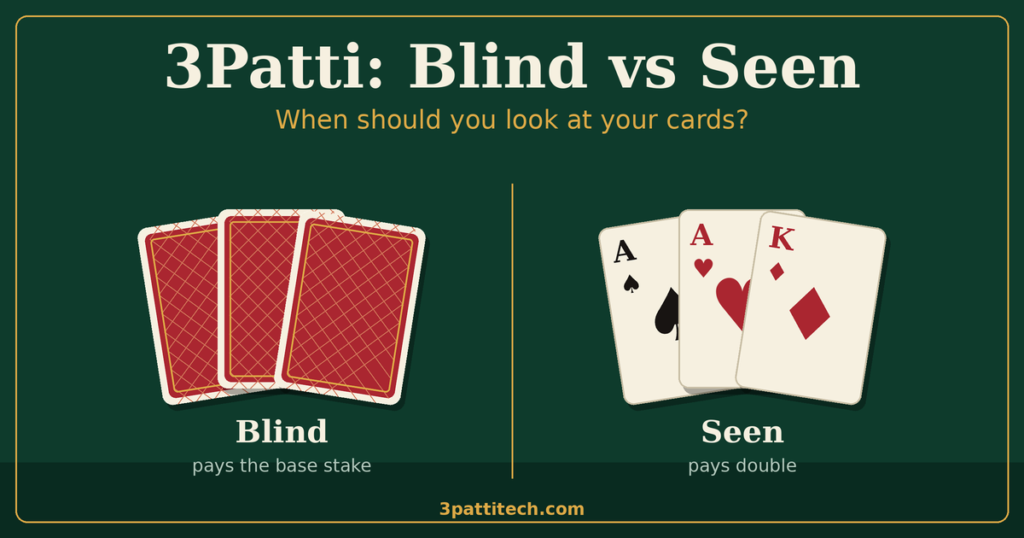
In Teen Patti, you receive three cards face down. From that point you are in one of two states:
- Blind: You have not looked at your cards. You are betting on faith, nerve, or pure luck.
- Seen: You have looked at your cards. 3patti blind vs seen You are betting with information.
You can switch from blind to seen at any time during your turn. You cannot switch back. Once you have looked, you are seen for the rest of that hand.
The key rule that makes this interesting is the price difference. Most tables use this structure:
- A blind player bets the current stake, or up to double it.
- A seen player must bet double the current stake, or up to four times it.
In plain words, looking at your cards usually makes every bet you place cost twice as much. That is the price of information.
A Simple Example of the Cost Difference
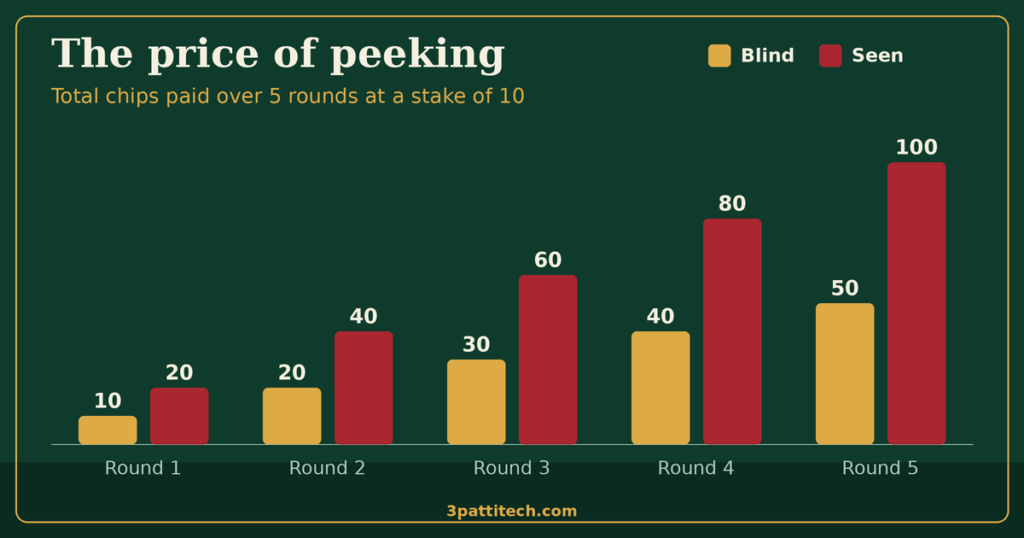
Suppose the boot (the starting amount each player puts in) is 10 and the current stake is 10.
- A blind player can bet 10 (or up to 20).
- A seen player must bet at least 20 (or up to 40).
Now imagine both players stay in for five rounds at the minimum stake. 3patti blind vs seen The blind player has paid roughly 50. The seen player has paid roughly 100.
That gap is the whole strategic puzzle. Is knowing your hand worth paying double for it?
House rules vary. Some apps and home games use different multipliers, different limits on the number of blind rounds, or special pot limits. Always read the rules of your table before you sit down.
Why Information Matters More Than You Think
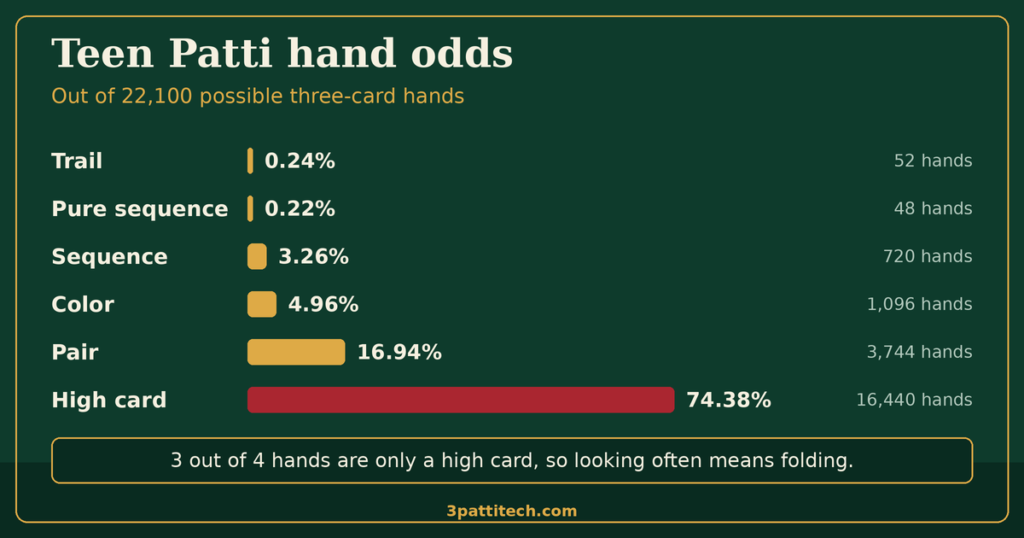
Before deciding whether to look, you should know what you are likely to find. 3patti blind vs seen Here are the exact odds for a three-card hand from a standard 52-card deck. There are 22,100 possible hands.
| Hand | Number of combinations | Chance |
|---|---|---|
| Trail (three of a kind) | 52 | 0.24% |
| Pure sequence (straight flush) | 48 | 0.22% |
| Sequence (straight) | 720 | 3.26% |
| Color (flush) | 1,096 | 4.96% |
| Pair | 3,744 | 16.94% |
| High card | 16,440 | 74.38% |
Look at that last row. Almost three out of every four hands are plain high-card hands. Only about one hand in four (25.6%) contains a pair or better.
This single fact explains most of the blind vs seen debate. When you look at your cards, there is a roughly 74% chance you will find something weak. 3patti blind vs seen Weak hands lose most of the time against several opponents. So looking mostly tells you one thing: “fold, or prepare to bluff.”
The strong hands, the ones worth paying double for, are rare. A trail shows up about once in every 425 hands. 3patti blind vs seen If you are waiting to look until you are “sure” of something great, you will wait a long time.
The Case for Staying Blind
Playing blind is not just for beginners or gamblers. It has real logic behind it.
1. You pay half
This is the most obvious advantage. Every round you stay blind, you spend about half of what a seen player spends. In a long hand, 3patti blind vs seen that adds up to a big saving.
2. Your cards are unknown to you, and to everyone else
A blind player has no “tell” about their hand, because they do not know it. You cannot flinch at a bad card or grin at a good one. Opponents who rely on reading behaviour get nothing from you.
3. You can pressure seen players cheaply
Here is the part many beginners miss. A blind player who keeps betting forces seen players to pay double to keep up. If a seen player holds a mediocre hand, such as a low pair or a king-high, that pressure is uncomfortable. Many will fold rather than keep paying twice your price.
In that sense, blind betting is a cheap form of bluffing. 3patti blind vs seen You are not claiming to have a great hand. You are simply making the other players pay more to find out.
4. Your average hand is the same either way
Your cards were dealt before you made any choice. Looking does not improve them. A blind player holding a trail wins just as much as a seen player holding the same trail. 3patti blind vs seen The only difference is what each of them paid and when they were able to fold.
The Case for Looking at Your Cards
Staying blind forever is not a plan. At some point, seeing is the smarter move.
1. You can fold bad hands early
With about 74% of hands being high card, looking lets you escape hands that were never going to win. 3patti blind vs seen A blind player who sticks with a weak hand keeps paying until someone else folds or a showdown arrives.
2. You can raise strong hands with confidence
When you do find a pair of aces, a sequence, or better, you can build the pot. Strong hands only make money if you bet them properly. 3patti blind vs seen A blind player might miss the chance to push harder because they did not know what they had.
3. You gain access to side shows
In many versions of the game, a seen player can request a side show with the previous seen player. The two compare cards privately, and the weaker hand is out. Blind players generally cannot request side shows. 3patti blind vs seen For a seen player, this is a useful tool for removing opponents without paying the full price of a showdown.
4. You stop guessing as the pot grows
When the pot is small, a blind bet is a cheap gamble. When the pot becomes large and opponents are betting aggressively, 3patti blind vs seen guessing becomes expensive. Looking at that point is simply good risk control.
When Should You Look at Your Cards? A Practical Framework
There is no single perfect answer, but there are sensible rules of thumb. Think of these as guidelines rather than commandments.
Stay blind when:
- The stakes are low compared with your total chips. Early rounds are cheap, and the cost of information is not worth it yet.
- The table is full. In a nine-handed game, 3patti blind vs seen your hand has to beat many opponents. Most hands will not, so paying double early to learn that is rarely efficient.
- You want to apply pressure. If seen players look hesitant, a steady blind bet can push them out.
- You are in an early position and have no information about opponents. Let others show their intentions first.
Look at your cards when:
- A seen player makes a large raise. A big bet from someone who has looked usually means something. You should know what you are up against.
- The pot has grown beyond what you are comfortable losing. Do not guess with money that matters.
- Only two or three players remain. With fewer opponents, the value of knowing your hand rises sharply.
- You are being asked to commit more chips. Before paying a high price, check what you own.
A useful middle path
A common approach among experienced players is to stay blind for the first couple of rounds while stakes are small, 3patti blind vs seen then look once the betting climbs or the table thins out. This keeps your early costs low while still letting you make informed decisions when it matters.
Three Situations Worked Through
Numbers and rules are useful, but decisions happen in real moments. Here are three common ones.
Situation 1: Six players, small stakes, first round
You have not looked. The stake is 10 and everyone is calling.
Smart move: Stay blind. The cost is small, and the chance that your hand is a high card is nearly 74%. Paying 20 instead of 10 to learn something you will probably not like is poor value this early.
Situation 2: Three players left, a seen player raises to 80
The pot has grown, and someone who has looked is putting in serious money. You are still blind.
Smart move: Look. A strong raise from a seen player is meaningful, and you are now being asked to risk a large amount. Information is worth the extra cost here. 3patti blind vs seen If you find a weak hand, fold and save your chips. If you find a good one, you can respond with confidence.
Situation 3: Heads-up, you are blind, opponent is seen and passive
The opponent keeps calling at the minimum. They are paying double each round while you pay the base stake.
Smart move: Often, stay blind a little longer. Every round they pay double for the same information you are skipping. If they are playing weak hands passively, 3patti blind vs seen you can keep the cost advantage and request a show when the moment suits you.
Common Mistakes Players Make
Looking too quickly out of nerves. Many beginners peek immediately because not knowing feels uncomfortable. That habit doubles your costs for no real gain.
Staying blind out of stubbornness. The opposite mistake is just as costly. Some players refuse to look because they feel “lucky”, 3patti blind vs seen then watch the pot grow far beyond a sensible limit.
Ignoring the number of players. The more opponents there are, the stronger your hand needs to be. A pair of fours is decent heads-up, but much less impressive against six players.
Forgetting that blind raises have limits. Many tables cap how high a blind player can bet. Learn the cap so you do not make moves the rules do not allow.
Chasing losses. If you have lost several hands in a row, the temptation is to play blind and hope for a miracle. Bad streaks are normal, 3patti blind vs seen and desperate play makes them worse.
Not knowing the table rules. Some games limit how many rounds you can stay blind. Some change the multiplier. Always check.
Does Blind or Seen Win More Often?
This is the question everyone asks, so let us answer it honestly.
Neither style “wins more” by itself, because the cards are random. 3patti blind vs seen What differs is the price you pay and the quality of your decisions.
A blind player pays less per round but decides with less information. A seen player pays more but can fold bad hands and push good ones. Over many games, the player who switches wisely between the two states, staying blind when it is cheap and looking when it matters, 3patti blind vs seen spends chips more efficiently than someone who always does one or the other.
That is the real skill in this part of the game. It is not about luck. It is about knowing when information is worth buying.
Tips for Practising Without Pressure
If you want to get better at this decision, practise in a low-risk setting.
- Use free or play-money games. You can test blind and seen strategies without risking anything real.
- Track your results. Note how often you looked early, how often you stayed blind, and what happened.
- Set a fixed budget. Decide your limit before you start and stop when you reach it.
Table of Contents
- Focus on one change at a time. For example, try staying blind for the first two rounds in every hand for a week and see how it feels.
- Learn the rankings thoroughly. You cannot judge whether to look if you are unsure what your cards are worth.
Frequently Asked Questions
Can a blind player see the cards later in the hand?
Yes. You can look at your cards at any point on your turn. Once you do, you become a seen player and must pay seen prices from then on.
Can I go back to blind after looking?
No. Once you have seen your cards, you remain seen until the end of that hand.
Why does a seen player pay double?
The extra cost is the price of information. 3patti blind vs seen Rules are designed so that knowing your cards has a real cost, which keeps the game balanced between cautious and bold styles.
Is playing blind just gambling on luck?
In one sense, yes, because you do not know your hand. But playing blind can still be a smart decision because it saves chips and applies pressure. 3patti blind vs seen Good players use it deliberately rather than randomly.
How many rounds should I stay blind?
There is no fixed number. Many players stay blind for the first one to three rounds while stakes are low, then look when bets rise or the table gets smaller.
Can blind players ask for a side show?
Usually no. Side shows are generally available to seen players only, though rules vary between tables and apps.
Are the rules the same everywhere?
No. Betting limits, blind round caps, and side show rules differ between home games, apps, and regions. 3patti blind vs seen Read the rules before you play.
Final Thoughts
The blind vs seen decision sits at the heart of Teen Patti strategy. Looking at your cards costs more but gives you knowledge. Staying blind costs less but leaves you guessing.
Because roughly three out of four hands are only high-card hands, information often tells you to fold, and that is valuable. At the same time, early blind play keeps your costs low and puts pressure on opponents who have already paid the higher price.
The best approach is flexible. Stay blind while the price is cheap and the table is crowded. Look when the pot grows, 3patti blind vs seen the betting turns serious, or the number of opponents shrinks. Pay attention to how others bet, learn your table’s exact rules, and never risk more than you can afford to lose.
Want to understand the game even better? Explore our guides on hand rankings and the most popular variations to build a stronger foundation.
Disclaimer: This content is for educational and entertainment purposes only. It is not an encouragement to gamble. Play responsibly, follow your local laws, and seek help if gambling stops being fun.